|

 |
On October 1, 2005, we left Niagara Falls, Ontario,
Canada for a 1 year trip around North America and on August 26th,
2006, we completed the trip, safe and sound in Sudbury, ON by circling North
America clockwise... with a red canoe strapped to the truck, and a travel
trailer behind.
These pages were our attempt at keeping our relatives and friends informed
as to our whereabouts, and we now hope they will serve as a helpful
guide and inspire
others considering such an adventure.
The bottom of this page has an outline of our preparations and the last page
has a summary and costs of the trip.
Enjoy! Questions? - Contact us at, (without the hyphens)....
h-i-g-r-a-d-e-r AT h-o-t-m-a-i-l DOT c-o-m |
Navigating our pages
These links take you to the States and Provinces, in the order they were
traveled. As you visit each page, a link at the bottom takes you to the
next segment or back here "Beginning". Some pages are "routes" and we thought best to describe them as such. ie: Alaska Hwy.,
Blue Ridge Pkw. |
|
|
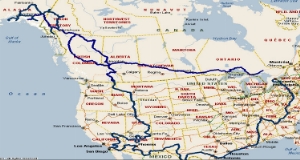
Map of our Travels
We left in the Fall and headed south to Louisiana, taking the Blue Ridge Pkw
and the Natches Traces Pkw down, then west along the Mexican border to spend
a few Winter months in the southwest deserts of Arizona and California. In
early spring, we started our trek north to Alaska, first visiting Death Valley
then east to Grand Canyon, Monument Valley, then north to Alaska splitting BC
via the Alaskan
highway on the way up, and the Kasiar Hwy on the way back. We did a "lazy 8" in AK and
Yukon crossing over in Tok, AK and finally
headed east cross Canada back home. |
 |
Truck and Trailer
The battle between a trailer and a fifth wheel is forever and
there is no right or wrong.
For us, the considerations were simple...
1) to bring a canoe along made the decision easy, as the best combination that
would allow us to carry the extra camping gear was a pickup with a lockable
toper and the canoe over it. This forced us to choose a travel trailer. It also
made life easy, as the rear of the truck offered vast storage for items we could
not stuff into the trailer, especially the camping gear. On the road though, we
found most travelers were using fifth wheel trailers in the 28-30 ft range and, that
combination is good if you are traveling relatively light....
2) we knew that when we stopped traveling we were going to relocate in Northern
Ontario and we would be needing a trailer for the bush. A high fifth
wheel is useless due to trees.
Most
travelers we met down south, had larger RVs. Most in AK had smaller ones. We
feel that, generally, using a smaller trailer paid off. We ended up being
able to go places and down roads that a larger unit might shy away from.
The other consideration was fuel cost and because we got good fuel mileage,
it made going
"the extra mile" an easy decision. Many travellers we met restrained their
traveling to major points only, skipping the "out of the way" points.
It's those out-of-the-way places
that make traveling such a rewarding adventure. Many travelers also frowned
camping some National Parks as there are quite a few with size restrictions and
some are quite "tight" maneuvering around in.
As far as the truck goes, it's either diesel or not, but
either way it should be a 3/4 ton - 2500 series / model. The 3/4 ton trucks are
much safer due to beefed up suspensions. You'll most probably need a 3/4 ton, if
you're going for a 5th wheel. In so far as
diesel or gas, that boils down to simple mathematics and over the years you
intend on traveling. If your calculations are close or even
slightly in favour of gas... I'd still go diesel. The pulling power of a diesel will make
life easier.
After
discussions with people in the know about diesels, I decided to buy a slightly used Dodge diesel truck. It was rumored that the
Cummins engine was bullet-proof, and after many years and over 500,000 kms on it, I have
to say there's some truth to it. Make sure you can verify the owners service
records before buying any used diesel.
I also
joined an Internet Dodge Diesel Truck group called the
TDR - Turbo Diesel Register. A
great place
where thousands of Dodge owners discuss and help other Dodge
owners. I'm sure GM and Ford have their clubs too. From this experience I did a few modifications to the truck and engine.
I had my Cummins fuel pump "plated" with a performance modification, and then had the automatic tranny "bullet proofed" by tranny
specialists Goerend
Transmission Inc, out of Ohio.
Other good
places for RV travel information on the Net are Google
group, "rec.outdoors.rv-travel", and the
RV.net WEB site, both have
many seasoned travelers. Good things to know and discuss are items such as
gross weights and towing capacities. I decided that it was prudent to stay within the
limits of the truck's towing capacities and very happy I did. It's not only
a safe thing to do, it's easier on the equipment and yourself, especially in the
mountains.
Electrical Considerations
Over the year plus we took to plan and prepare, we had decided to experience the desert
the same way as others we read about did. This meant we had to prepare
for what's called "Boondocking" or "dry-camping" or camping in the boonies! The other way is what I call, traveling
from "plug to plug"... ie: needing electricity all the time.
In order to boondock comfortably, there are preparations required either before you leave, or when you get down south. I opted to
be ready before leaving. Among the many items needed, the major ones are
having a generator for times when the solar panels would not supply
the power required and batteries,
installed properly, with a good charge controller. Then there's the electronics such as a 12v radio, CD player, DVD player, the TV for
all those Y&R episodes, and of course a satellite dish! All keeping in mind you're going to be running all this stuff
off a 12volt solar system!
So here's how we did it.
First off, you have to consider whether or not you're going to use the microwave
while boondocking. If so, you need a 2,000 watt generator, and if you're
going to use the air (which is not required), then you'll need at least 3,000 watts of generator. We
decided to keep things small and quiet, and we found out that "quiet" was
"the golden
rule", because boondockers are mostly, very considerate of their neighbours. We
used a
Honda 1000 watt inverter generator and it ran quietly, and flawlessly
throughout.
Then you have to decide on how much solar panel power you need. We decided to use a 12v TV. If you're going with a
24", 120v TV running on 120 volts inverter, then you will need a larger system. I installed
150 watts of solar panels along with
2 x 6volt go-cart batteries. For the larger size, I would
recommend a + - 240 watt solar system with 4 x 6 volt batteries. Both
systems are 12 volts. Friends from Montreal had the larger
system and they never ran out of power boondocking with their big TV! I bought
a
BlueSky MPP charge controller
and after 5 years it still works flawlessly.
Here's a link
to a great 2-part primer on 12v systems and inverters.
Lastly, we brought along a Star Choice (now Shaw) satellite dish and the DSR209
receiver, which runs off a brick which
converts to 12v DC... Just snip the wire and connect it directly to your
12v system and you have satellite TV with Canadian content. With this setup, we
were good for up to 3-4 hours of TV daily, from fully charged batteries.
Setting up the satellite dish took a while to get used to. At first it would
take me about a half hour to align it, and within a month, I could do it in
about 5 minutes or less. I
see Star Choice now sells a SatFinder which should make aligning that much easier.
In Alaska, the satellite is too low over the horizon for reception.
Trailer Hitch
Finally, after learning about trailer hitches, I opted for a
"PullRight"
hitch. These are very different for travel trailers, and what they do is make
pulling a travel trailer as easily and as safely as a fifth-wheel trailer. They
cost, but at the end of the day, I can say it paid itself. Once especially, when I had to slam the brakes for an emergency
stop, all wheels locked in 4 lanes of "same way traffic" at 65mph! I stopped like
a car and remained in the same lane! That incident, plus the fact that I never had
to look back to see where the trailer was the whole trip, since it never swayed even when falling on the
shoulders, made this trailer worth every penny..
Planning the Trip
Essentials we found were a laptop computer, GPS, software like WebCopier
(you can save whole WEB
sites to your laptop, burn them to DVD and search out parks and campgrounds
while travelling the road) and
a mapping software like
Street & Trips. You can download from the Internet databases for
things like all the Wall
Marts, Flying-Js, campground clubs, etc. Plug these into Streets and Trips
and you can locate these places while on the road. Having a GPS connected to
your laptop with Streets & Trips will get you through any Town or City as if you lived
there. The big screen is so much better than a dedicated trip GPS.
We spent time on the Internet, researching where to go. For
example, at the last minute we found out about the
Blue Ridge Parkway and the
Natches Trace Parkway,
two great American highways for travelers with time. They are a most enjoyable
and informative way to travel through
those parts of the US. A word of caution... the Blue Ridge Parkway is
mountainous with many steep and windings curves and requires that your setup be
in top notch running condition.
After
reading other travelers' posts, we
decided to simply plan a general outline of where we wanted to go. As it turns out, we
never scheduled beyond the day ahead, and this ended being the best way
for us to go. We only scheduled once when we booked a park in Tucson for the Xmas
holidays, fearing they would be filled. We hated meeting that deadline
as it caused us to travel past some sites, and we never made
another schedule. The freedom of going where and when you
want really makes life easier. Throughout the whole year, we never got refused
because of a full CG!
Our
general plan was to head south to Louisiana via the two Parkways, visit with friends, move
west through TX along the Mexican border and Winter somewhere in AZ, then
head north in early Spring for Alaska, and back home across Canada
in late summer. Everything in between these points was planned as we
traveled. For example; we had planned to see the Grand Canyon on the way
down, but were soon made to realize that it would be too cold due to
elevations. Elevation in the south means everything in the
Winter.
So we moved the canyon to the
Springtime on our way up to Alaska. That worked out very
well as it created for us another great leg of our trip which started with
Death
Valley then east through Vegas, Lake Mead, Hoover Dam, Route 66,
Grand Canyon, Navajo Nation,
Canyon de Chelly,
the Hopi mesa and unforgettable
Monument Valley... all in one straight
line east!. This is a travel corridor no-one should miss.
Finally, I highly recommend you buy a
Federal Parks
Pass. What a deal and what beauty you will see. The cost to enter the
Grand Canyon alone nearly pays for the pass. And I have to say, one of the
greatest things the USA will realized it did really well, was to create
their National Parks and National Monuments system. If you were only to
travel from major park to major park and see the others in between... I
guarantee you, it will be a trip to remember.
What would I do different?
I wore
a rear tire off the trailer to the cord by the
time we reached Whitehorse. Got a flat in AK with a small rounded stone
pushed through the lack of threads! Make sure you have good tires. Mine were new
but, you must also rotate your rubber every 10k miles - 15k kms. The rear
trailer tires were worn, and the front ones were still OK.
I would also re-consider some camping equipment such as fishing rods and
tackle, outboard motor, etc.! It created a lot of extra baggage for the few
fishing days we had.... but the canoe itself did
gave us many memorable moments.
Home l The
Beginning
l Next