
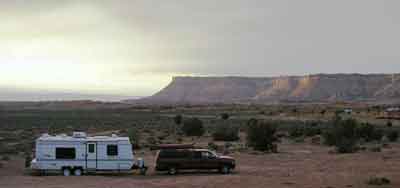
| Summary of the trip. (by Denis) As you can see from this picture, we're in the desert. In Canyonlands National Park, Utah, and we're miles from anything urban.
There isn't even an electrical pole for 50 miles around. |
 |
|
Boondocking / Dry-camping Rich or poor, boondocking is a great way to travel, to see places you only see in magazines, and meet great folks. And that's why we're glad we set ourselves up for boondocking. Though the up-front costs are higher and preparation takes longer, it's worth the effort. We really feel we saved a
lot by boondocking and that our trip was that much better because of it. US
National Parks offer no hook-ups but have water on the way in and a dump on
the way out. Solar panels will extend your stay for many days and most parks
deserve it. Some don't allow generators, while all restrict their use. Boondocking is a state of mind. It helps you to realize the importance of being environmentally friendly. You're closer to nature, and you're always thinking conservation, keeping it clean, leaving it clean and packing it out. That's the way you got it, and that's the way you should leave it for the next camper, and if it wasn't. clean it!. We found the US is quite
ahead of Canada when it comes to camping. There must be a dozen government
departments involved in developing and up-keeping campgrounds and camping
places such as the Bureau of Land Management - BLM, the Dep't of
Agriculture, the Army Corps of Engineers - Corps, National Parks - NP,
etc... and we have found that these organizations keep things simple and
inexpensive, as compared to camping in Ontario. The US is more concerned
with making camping available for its citizens instead of gouging them with
pristine over-developed, under-staffed and expensive Provincial Parks like
we have in Ontario. Imagine paying $32 + $12 to reserve a campsite in
Ontario while in the US it's often $12-14 and ONLY on a first come first
serve basis.... Camphosts / Camp Host /
Camphosting / Camp Hosting / Like I said, boondocking is a state of mind and it lends itself to thinking outside the box. Some National Parks have a restriction on size of trailer. If you're travelling with a 36' Fifth Wheel or a Class "A", you'll be hard pressed to get a campsite big enough. Having a unit that's not too large saves on fuel. Saving on fuel, allows you to travel that extra distance and see spectacular places. Having a rig that's easy to tow allows you to go into wilderness places with ease, and being self sufficient for boondocking, well... that allows you to stay there for days, giving you more quality time to do what you came for. As compared to some other
travellers we have talked to, I'd say we travelled at a reasonable cost. It
wasn't cheap, but it surely wasn't on the high side either. We did not limit
ourselves on travelling as we went down roads that are still difficult to
find on maps. We did not miss too many attractions along the way either.
From National parks to caves, to helicopter rides over the Grand Canyon.
Again, the one card you cannot leave without, is the yearly pass for the US
National parks. Another money saver... BLM camping pass at about $175.00 for
the whole Winter, it's a great experience camping out in the desert. And if
you like hiking, desert excursions are an experience. Travel Expenses / Costs
- Budget We planned a year and spent 11 months 7 days on the road. We travelled a bit over 40,600 kms and of that 26,339 kms were from campsite to campsite, our direct line of travel. That left 14,300 kms of side trips / excursions! We had estimated the cost at $25,000.00 US ($32k Cdn) and we were expecting to add more. As it turned out, it cost us less! This is the breakdown in US dollars since most of it was spent there. Item Estimate Actual Campgrounds $4,500.00 $2,371.00 Food $5,500.00 $4,320.00 Attractions $3,000.00 $2,035.00 Miscellaneous $5,000.00 $5,600.00 Insurance $2,000.00 $2,000.00 Fuel $5,000.00 $4,870.00 Totals $25,000.00 US $21,196.00 US
What we set aside minus
what we came back with, leaves an exact cost of $550.00 / week Cdn. We
probably averaged closer to $600.00 up in AK and $500.00 / week in the
southwest because we did park for about a total of 2 months in the Winter.
Out of the total 40,639 kms travelled, Niagara Falls to Sudbury, the long
way around, we poured 6,851 litres of fuel through the Cummins engine for an
overall 16.73 mpg Cdn, and we averaged $2.69 US / US gallon fuel - .85c Cdn
per litre, mostly due to cheaper US fuel vs ridiculous Canadian prices. We hope this write-up helps travellers thinking of undertaking such a trip... to do so. You will never regret it. Happy trails,
Velma and Denis
|
|
|