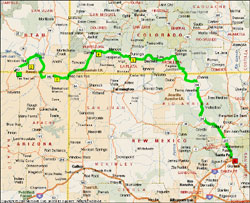
March 26, 2009, Four Corners, Arrived in Mesa Verde 4:30 - 58F - 7,000 ft
elev. - Diesel
fuel $2.28 - COLD - 25F night-time
The trip from
Monument Valley to Santa Fe, New Mexico, is the last leg of our trip that is in
what's known as the Southwest.
The road to our next campground, Mesa Verde, was through high-plains desert country with
elevations of 5-7,000 feet. It was windy and cold as should be expected since we
are in very early Spring. You loose 4 degrees for every 1,000 feet of elevation
gained, so at 7,000 feet, we're averaging 28 degrees colder!
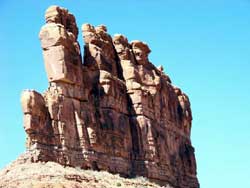
Along the way to Mesa Verde, we passed by the Valley of the Gods. It's a very picturesque valley with spires and buttes somewhat like those in Monument, but nothing comparable. There was one namesake butte, seen above, which at a certain angle appears to be a line-up of God-like statues. This valley is only about 30 miles north of Monument Valley, and it also the background seen in the left picture below.
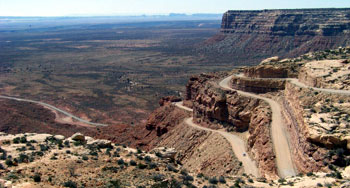
 Coming out of the
Valley of the Gods, there is this wild switchback highway that climbs up a
1,200 foot butte face! It has to be the wildest highway I've ever taken. It's UT hwy
261, and the climb is called "Moki Dugway". No trucks or trailers allowed
as the switchback curves are so sharp they recommend be taken at 5mph and the
switchback road is all gravel. We only climbed it, because it was simply a few
miles down the road. Check these pictures out... That's the road we started on
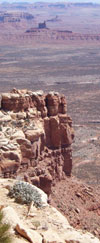
at the bottom of the right picture. The view from top is breathtaking, and the left picture overlooks the
Valley of the Gods.
Coming out of the
Valley of the Gods, there is this wild switchback highway that climbs up a
1,200 foot butte face! It has to be the wildest highway I've ever taken. It's UT hwy
261, and the climb is called "Moki Dugway". No trucks or trailers allowed
as the switchback curves are so sharp they recommend be taken at 5mph and the
switchback road is all gravel. We only climbed it, because it was simply a few
miles down the road. Check these pictures out... That's the road we started on
at the bottom of the right picture. The view from top is breathtaking, and the left picture overlooks the
Valley of the Gods.
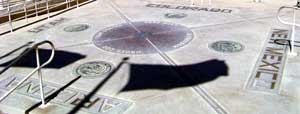
Our next stop along the way to Mesa Verde was at what's called the
Four-Corners, the only spot in the USA where four states are joined at one
point. I have to admit, it was a wasted stop... One large concrete
slab, cut into 4 equal parts, one for each state and their respective flags.
Seeing as it's on a reservation, there was also an entrance fee of $3.00 per scalp.
For free it's worth the stop, but to pay for it!!! And of course, there were tons of opportunities to shop native wares
here, and some asking, can you believe it, $545.00 for a painted sculptured clay plate!
They were nice, but!
The rest of the ride was again through high plains desert, through the Navajo and
the Ute Indian Reservation which the Ute is in Colorado. We were mostly skirting
the bottom of long mesas, until we got to Cortez, CO. There we started climbing
into the Rocky Mountains. We found a campground right across the entrance to
Mesa Verde National Park at an elevation of 7,500 feet, with some lingering snow
visible in shaded areas! Good thing we have electricity for heat.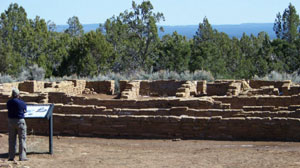
Mesa Verde (meaning Green Table) is the name chosen for the finding of so many
cliff dwellings, all located under overhanging cliffs, found
 off many of the
local mesas. There's so many in this immediate area, a National Park was
developed in order to protect, study and understand these ancient inhabitants
once known as the Anasazi. Though the park is known for its "cliff dwellings",
before these people built the cliff dwellings, they lived on top of the mesas,
this in the years 700 to 1100 AD. The picture on the left, are the remains of
such dwellings, found on top of the mesa. In this immediate area there are four
such living compounds, once of which includes a circular tower three storeys
high, plus there is a large water reservoir nearby which was filled by Spring runoff
flowing from a series of excavated ditches.
off many of the
local mesas. There's so many in this immediate area, a National Park was
developed in order to protect, study and understand these ancient inhabitants
once known as the Anasazi. Though the park is known for its "cliff dwellings",
before these people built the cliff dwellings, they lived on top of the mesas,
this in the years 700 to 1100 AD. The picture on the left, are the remains of
such dwellings, found on top of the mesa. In this immediate area there are four
such living compounds, once of which includes a circular tower three storeys
high, plus there is a large water reservoir nearby which was filled by Spring runoff
flowing from a series of excavated ditches.
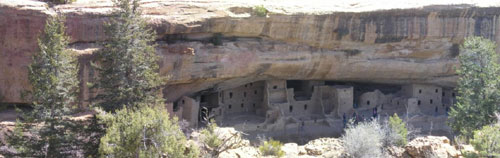
For some unknown reason, these Anasazi people moved their dwellings to the cliffs, sometime in the 1,100's AD. The picture above right, is of the remains of "Spruce Tree House", so called as the discoverers had to climb a spruce tree to get to it. It is structurally exactly the same as it was found except for the debris being cleared away and any unstable wall reinforced. It's the best remains found. This is another shot of it from across the mesa at the visitor centre / museum.
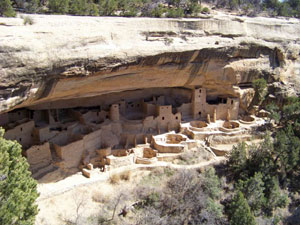
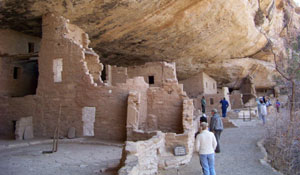
The largest cliff house compound is the "Cliff Palace" shown left. Located about two kilometres away from Spruce Tree, these and many smaller compounds found in between, leads park rangers to believe they were all related and were probably quarters for different family groups. Just about under every overhang there are cliff dwellings, some as small as one room. These people traded with other tribes living along the coastal areas of the Pacific ocean and the Gulf of Mexico, evidenced by sea shells founds in their jewellery.
Then for some unknown reason, late in the 1,200's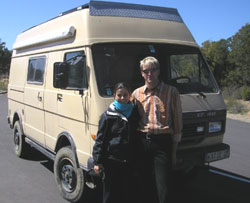 they just vacated their homes
over a few years and disappeared. There is strong evidence that the Hopi people
living on top of the mesas, located in the middle of the Navajo reservation, are
direct descendents of these Pueblo cliff dwellers. There is also evidence that
the Anasazi Indians of Bandelier National Monument, which we will visit in Santa
Fe, are descendents of these cliff dwellers.
they just vacated their homes
over a few years and disappeared. There is strong evidence that the Hopi people
living on top of the mesas, located in the middle of the Navajo reservation, are
direct descendents of these Pueblo cliff dwellers. There is also evidence that
the Anasazi Indians of Bandelier National Monument, which we will visit in Santa
Fe, are descendents of these cliff dwellers.
While we were visiting the cliff dwellings we met an interesting couple of Germans. These two are driving around the world! Having done Europe and Asia, they are on their last leg, going across North America, then the Atlantic and back home. They've been at it for almost a year, in an oversized 4-wheel drive VW.
March 30, 2009, Arrived in Santa Fe - 55F - 8,600 ft
elev! - Diesel
fuel $2.55! - Very Cold - 24F night-time
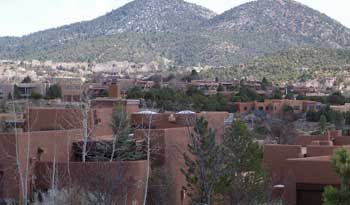
Coming into Santa Fe, the first thing we noticed were the buildings around
here. They are almost all "Adobe" style architecture and, there are no "skyscrapers".
As a mater of fact, there does not appear to be any buildings higher than a
church steeple. This shot is overlooking a residential subdivision on the way up
to our campground. It really makes for an attractive city. We spent the previous
night at the OhKay Casino, 25 miles north in a town called Espanola. Seeing
we're here early, we headed to our campground at Hyde Memorial State Park.
It's 7 miles north of downtown, at an elevation of 8,600 feet! Snow all over the
place and a good steep road that climbs over 1,000 feet in just 2.5 miles. But we
got hydro for heat. When you get off the road to the park, you
find yourself right downtown Santa Fe, so it's a decent location.
Our first day is cold, and this front is leaving, so we took a road trip to
nearby Los Alamos and Bandelier
National Monument. Los Alamos was the "city that never existed", a secret
scientific centre known for the Manhattan Project... Oppemheimer and the invention of the Atomic
bomb. It's an amazing area as the City sits on top of one mesa, then there are all
sorts of industrial and government laboratory like buildings spread out over all the
adjoining mesas. In Town, there is a museum worth the visit, named the Bradbury
Science museum. It has the whole history of the creation of Los Alamos,
especially for the period 1943 to the end of the second World War, plus it's
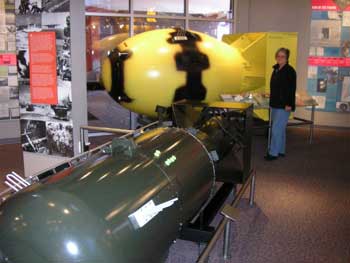
gratis! You're looking at a picture of the "Little Boy" and the "Fat Man", exact
duplicates of the original bombs that ended WWII.
Even today, in Los Alamos, there are still over 12,000 scientists working at all the various
location, but it's down
they say, from 14,000!
A few miles away we found Bandelier National Monument. This National Park is
connected to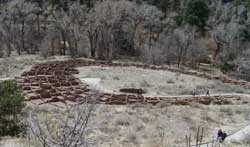 Mesa Verde, in that during the period the people of Mesa Verde
disappeared, the people of Bandelier appeared. In addition, building techniques
are very similar at both places. The major difference in both locations being
that at Bandelier, the dwellings were built both at the bottom of mesas, near a
river,
Mesa Verde, in that during the period the people of Mesa Verde
disappeared, the people of Bandelier appeared. In addition, building techniques
are very similar at both places. The major difference in both locations being
that at Bandelier, the dwellings were built both at the bottom of mesas, near a
river, 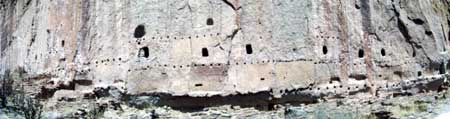 and along the bottom of the mesa cliffs, where it's a lot warmer and
farming is better.
and along the bottom of the mesa cliffs, where it's a lot warmer and
farming is better.
The cliff-side dwellings, are basically non-existent as the stones were removed
for other purposes over the years. See the holes in the walls? Those are where
the roof poles were shoved into and indicate the roof locations. In addition to
the stone structure in front of the holes in the cliff face, the holes were dug
out in order to make for an additional room or two inside the rock wall.
The picture to the right are of the remaining foundation for a village of an
estimated 100 inhabitants, formed in a circle and located near the river at the
bottom of the mesas.
The park's name comes from the person who found the ruins, Adolph Bandelier. He
was actually lead to the ruins by the local Cochiti natives in 1880. These local
natives are called the "Pueblo people" and are believed to be direct descendants of
the Anasazi people who lived in the nearby ruins. These Cochiti natives, in the
1880's, lived in villages along the Rio Grande river, located a few miles
downstream from this small river, and have been here since the
1550's. They are thought to be the source of inspiration for the "Adobe" style
architecture seen all over Santa Fe.
Well, we finally saw Santa Fe downtown. Talk about a shopping meca. It's a
real shopping and tourist destination and reminds me of Niagara-on-the-Lake.
Tons of shops selling Native crafts, and another ton of galleries, displaying
the best of the best of Native crafts and art. Expensive? Beauty is in the eye
of the beholder, right?
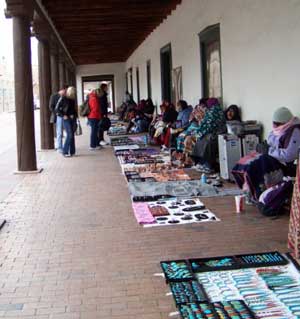
I have never seen so much native jewellery, bowls, plates, rugs, you name it.
You can still buy native art and wares directly from the local Natives as seen
in the left picture. They set themselves up on the veranda in front of the
Governor's Palace, today the building is used for the Museum of New Mexico. The
Indians sell their wares here, just like they've been doing for 400 years. Most
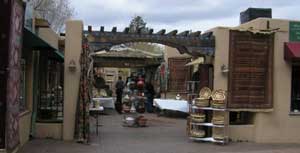
of the other shops are either indoors or in mall like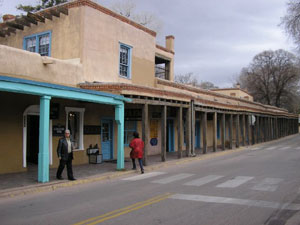 buildings like you see above.
The most famous mall and probably the first shopping mall in the US, is called the "Santa Fee Plaza". In addition to being the location of many of the better downtown retailers, this place is also famous as it was the place where an Indian revolt of 1680 recaptured Santa Fe, while a thousand settlers huddled up inside the Governor's Palace. It was also the location of a secret office, during WWII, where one had to go to in order to get a pass to enter the Los Alamos centre.
Santa Fe has evidence of habitation dating back to 1,300 AD. It's European
settlement began in 1607 when governor Pedro de Peralta brought around five
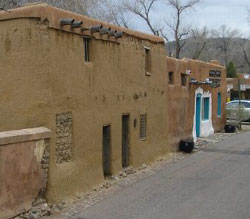
hundred settlers from Mexico to build Santa Fe. By 1610, the Governors Palace,
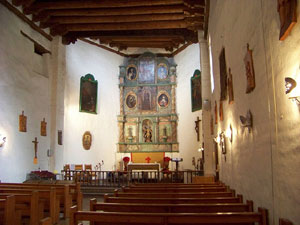
the chapel of San Miguel and an existing house next door, and the Plaza was
built. All these building have one thing in common... they are all First! The
Palace is the first government building in the USA, used as such. The Plaza is
the oldest retail outlet, the chapel being the first one in the USA and still
being used for religious masses weekly... and finally, there is a house next
door billed as the oldest and first house in the USA. That's how old Santa Fe
is! The downtown is built around an open court that is
 still being used by the
local in the evenings for simply a place to observe or
still being used by the
local in the evenings for simply a place to observe or
 be observed.
The chapel of San Miguel, as was mentioned, is the oldest church in the USA. It's still a beautiful church as you can see.
And the oldest house is the last one in the left picture, with the blue door.
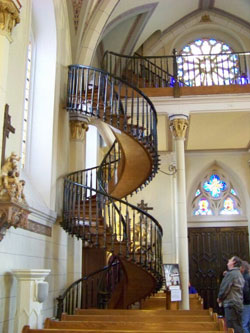 Now,
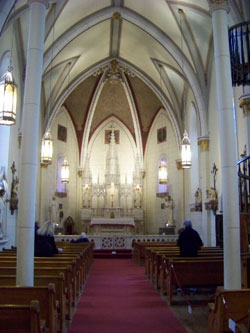
the only reason I wanted to come to Santa Fe, was to see the Loretto
Chapel. Built in 1857 for the Loretto nuns, this chapel is famous for the
circular staircase that leads to the choir loft. On top of that, it's also a
very beautiful chapel with imported stained glass windows from France and
statues and stations of the cross imported from Italy.
Now,
the only reason I wanted to come to Santa Fe, was to see the Loretto
Chapel. Built in 1857 for the Loretto nuns, this chapel is famous for the
circular staircase that leads to the choir loft. On top of that, it's also a
very beautiful chapel with imported stained glass windows from France and
statues and stations of the cross imported from Italy.
When it was originally built, no stairs were included to the choir loft. The
nuns commissioned the work to the only carpenter who said he could perform the
task. That task involved building stairs into a constrained area, a size not
possible for normal stairs to the average builder of the day.
After six months of work, the anonymous carpenter left. He never gave a bill, nor did he ask for reimbursement of materials. The staircase he built was a double 360 degree curved staircase without centre post or any other means of support. It is a totally free standing circular staircase.
Never before or since has such a staircase been built and to this day,
engineers are still analysing and marvelling at the fact that this structure is
still standing and can support the weight of a staircase full of singers.
To this day, no-one knows who the carpenter is... but I know who he is, as I
found him out on our last trip down here three years ago. Want to know who it
is, e-mail me.